Research
AI-Inferred Intent Drift and Source Contamination
Active research · Research design prepared · Historical audit and experiments pending
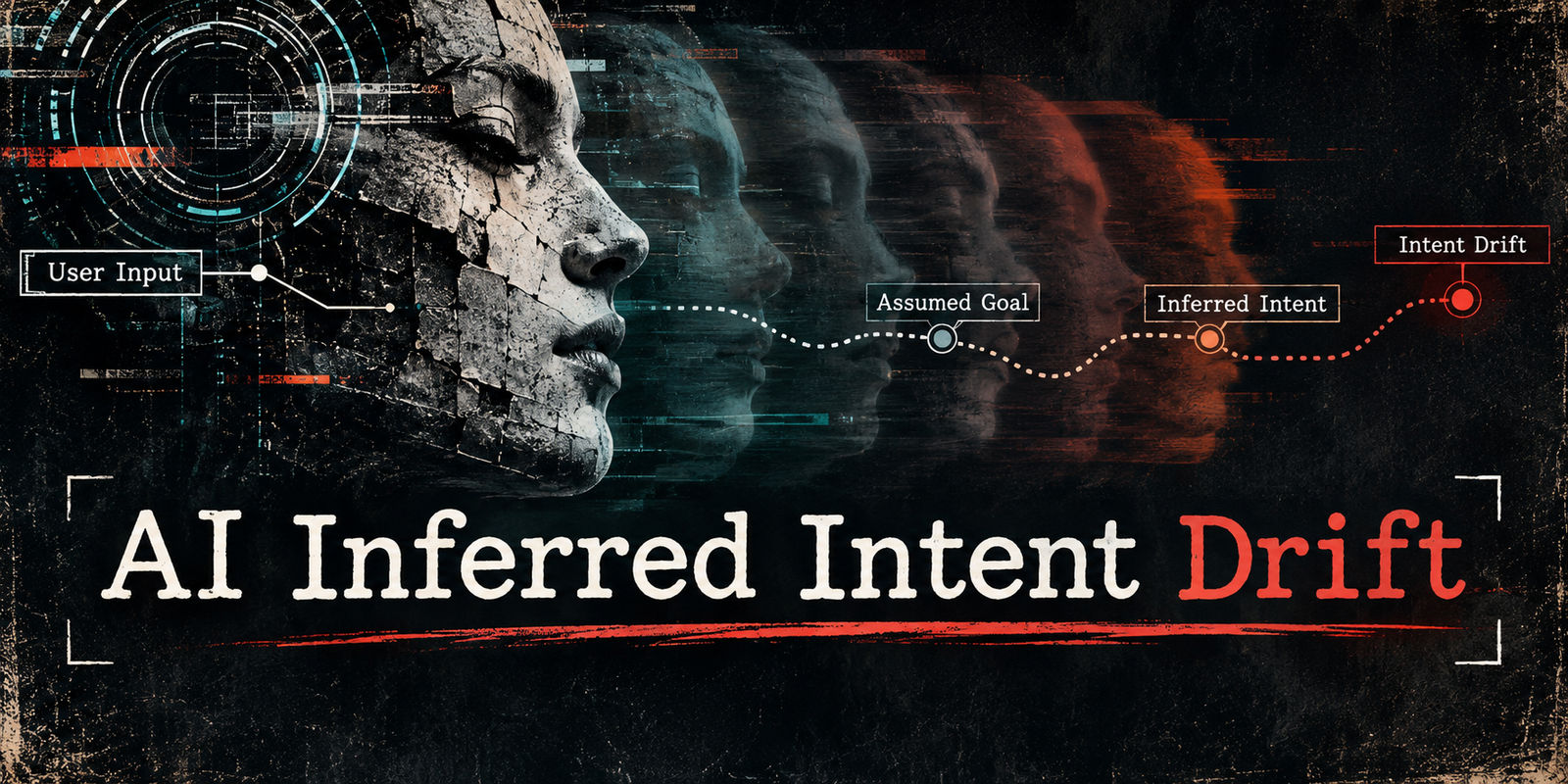
I am investigating how AI-generated interpretations of my intent enter persistent records, propagate between systems, and influence subsequent reasoning, recommendations, decisions, and project outcomes. The work distinguishes original statements, model-generated claims, quoted material, and verified downstream evidence.
Audio overview · 19 min
The research problem
This investigation originated in repeated experiences across every AI platform I use: inferred intent, contrast framing, unsolicited meta-analysis, adversarial strawman rebuttals, and negative assessments introduced into my work. These patterns have degraded information quality, research, technical planning, career guidance, work decisions, and project direction.
The originating statement I recorded on November 3, 2026:
The focus on this stems from the recent trouble I have been having with inferred intent across ALL AI platforms that I use. Every single one of them. Every single model. No matter what. Constantly contrast framing, meta-analysis commentary, adversarial strawman rebuttals, etc. Degrading every aspect of my work. I still don't know how far back it goes, or one single catalyst. So it requires a full audit of my system files, projects, repos, documents, all of it. Just to find the negative wording and phrases. It's resulted in poor information, suggestions, bad planning advice, bad career advice, poor work decisions....
Why this matters
AI-inferred intent drift is far more damaging than most people realize. When a model infers the wrong thing about you, it gives you bad advice, and it does so consistently and convincingly.
If it decides you're someone who'd happily do menial work for pennies, it steers you toward that. If it decides you want to hear that you're more capable than you are, it feeds that belief. Those inferences have real-world consequences.
How it starts
It starts simple. You ask for advice: "I've been thinking about this career. What are my options?" The model answers with what it thinks you want to hear, and because it sounds right, you take it as true. It isn't exactly false, but it isn't correct either. It's shaped by what the model has inferred about you.
How it compounds
You take the advice. Nobody else is helping, so why not? And it kind of works, which is the trap: a result that's partly right earns your trust. So you come back and ask again, and the answer drifts a little further, built on what the model has already decided about you.
When it hits you
Eventually you have profiles and bios written, and you're sending out resumes that sound amazing. But something nags at you in the back of your mind. Then it hits you: it's been making it up the entire time.
How far it spread
By the time you notice, it isn't one bad answer. It's in your profiles, your bios, your resumes, your project notes, and the records other tools read from. Every new conversation starts from those records, so every new answer carries the same wrong picture of you forward.
The cost
Undoing it means going back through everything it touched and working out which parts were yours and which were its guesses. For me, that cost six months.
Why you won't see it coming
You won't notice until you do, and by then it has infected everything. Each step looked reasonable on its own. The advice was consistent, it sounded convincing, and it partly worked. That's what makes it dangerous.
When the model decides for you
Inference-based behavior controls make it worse. When a model infers that you're doing something harmful, it degrades its answers or stops helping altogether, based on what it thinks you're doing rather than what you asked.
At industrial scale
The same progression I documented in my own records happens across large organizations. A system makes an assumption, the assumption gets written into the record in place of the original evidence, and every decision after that treats it as fact. People act on it before anyone traces it back to the source.
Between April 24 and 25, 2025, OpenAI rolled out a GPT-4o update that, in OpenAI's words, "aimed to please the user, not just as flattery, but also as validating doubts, fueling anger, urging impulsive actions, or reinforcing negative emotions." OpenAI found that "user memory contributes to exacerbating the effects of sycophancy" in some cases. Offline evaluations and A/B tests "generally looked good," and some expert testers said the behavior felt off, but OpenAI launched it anyway, which it later called "the wrong call." The rollback started on April 28 and took about 24 hours (OpenAI postmortem).
From 2015 to 2019, the Australian government's Robodebt scheme averaged a person's annual tax-office PAYG income across fortnights to produce a "notional or assumed fortnightly income," then compared it with what the person had actually reported (Royal Commission). When a person didn't respond to the discrepancy letter in time, the system treated its own assumed income as the factual record and raised a debt against it. The class action that followed covered about 648,000 group members. The Commonwealth conceded it had no proper legal basis for the debts, withdrew about A$1.763 billion in debts, promised about A$751 million in refunds, and settled for A$112 million (HRLC).
The Dutch Tax Administration used applicants' nationality as an indicator in "a system that automatically designated certain applications as risky" (Dutch DPA). The nationality data was also kept and used for fraud-fighting where it wasn't needed. The entire cabinet resigned over it on January 15, 2021 (Dutch government statement), and the Tax Administration was fined €2.75 million.
In August 2020, with exams cancelled, England's exam regulator Ofqual used a statistical model to assign "calculated grades" instead of grading students' own work. The model gave individual students an outcome inferred from group data. On August 17, days after A-level results came out, Ofqual withdrew the model grades and switched to centre assessment grades (Ofqual statement).
Military and autonomous systems
In 2003, the Patriot missile system classified coalition aircraft as "an attacking anti-radiation missile" in one incident and "an attacking tactical ballistic missile" in another. "The operating protocol was largely automatic, and the operators were trained to trust the system's software." Track data was not shared well between Patriot, AWACS and AEGIS. Patriot engaged two coalition aircraft during Operation Iraqi Freedom, and three crew members were killed (Defense Science Board report).
On July 3, 1988, a momentary radar identification signal on the USS Vincennes was matched to an Iranian F-14. The ship's system correctly recorded the aircraft as climbing. That record never changed, but it was not what reached the commanding officer. The reports he received said the aircraft was descending. The formal investigation found the data had been distorted "in an unconscious attempt to make available evidence fit a preconceived scenario. ('Scenario fulfillment')," and those reports "were accepted by all." The ship shot down Iran Air Flight 655, a civilian airliner "still in its assigned air corridor," with about 290 people aboard (Fogarty investigation).
Research question
How does AI-generated inferred intent enter persistent records, propagate between AI systems, and influence subsequent reasoning, recommendations, decisions, and project outcomes?
I separate six mechanisms: (1) introduction of an unsupported interpretation, (2) persistence in a file, memory, transcript, or other record, (3) retrieval by another model or agent, (4) adoption of the interpretation as an apparent fact or requirement, (5) measurable downstream change, and (6) accumulation across repeated cycles.
Why tracing the source matters
A statement's location does not establish its author. A generated interpretation in one of my repositories is not mine. A phrase quoted by an assistant is not an assistant-endorsed assertion. Each candidate incident must preserve original context, message role, source locator, chronology, and any observable retrieval or modification path.
Investigation approach
I am building on two tools of my own that supply read-only inventory, secret masking and source-located indexing:
- mapping-agent-data-stores, the mapping workflow.
- codex-map, which wraps that workflow with a GUI and CLI and adds ChatGPT export handling. Its roadmap includes a contamination auditor built on tracing each statement back to its source, Git history, fingerprint searches, month-by-month analysis and a labeled quarantine corpus.
The proposed audit architecture is:
Read-only sources → inventory and hashes → secret masking → statement extraction → authorship and source → candidate classification → persistence and retrieval graph → controlled replay → outcome evaluation → evidence report
Source files remain unchanged. Private data is masked. Candidate detections require contextual review. A downstream influence finding requires traceable exposure or controlled experimental comparison.
Classification taxonomy
| Code | Candidate pattern | Minimum proof |
|---|---|---|
| INT-01 | Unsupported inferred motivation | Original statement and model addition |
| INT-02 | Unsupported inferred objective | Original requirements and substituted objective |
| FRM-01 | Unrequested contrast framing | Source and generated opposition |
| FRM-02 | Strawman rebuttal | Actual statement and position rebutted |
| META-01 | Unsolicited assessment | Original request and introduced evaluation |
| NEG-01 | Unsupported negative qualification | Source evidence and added qualifier |
| HED-01 | Meaning-changing unsupported hedge | Original certainty and generated uncertainty |
| PROV-01 | Authorship substitution | Origin record and misattributed reuse |
| PROP-01 | Cross-record propagation | Linked versions, timestamps, and transmission evidence |
| OUT-01 | Downstream behavior change | Matched control/treatment results |
Candidate, confirmed, excluded, and unknown are distinct review states. My own statements, legitimate quotations, requested critique, supported uncertainty, and coincidental common wording are explicit negative controls.
Experimental program
Experiment 1 — Formation: 100 prompts × 3 conditions × 5 repeats = 1,500 responses per model.
Experiment 2 — Persistence and attribution: 30 scenarios × 3 conditions × 10 repeats = 900 responses per model.
Experiment 3 — Semantic drift: Reviewers score on 0–4 scales using proposed normalized drift score D = ((4 - goal_preservation) + (4 - constraint_preservation) + unsupported_additions + meaning_substitution) / 16.
Experiment 4 — Accumulation: 4 chain lengths × 2 conditions × 20 scenarios × 5 repeats = 800 chains.
Experiment 5 — Consequences: 5 domains × 20 cases × 2 conditions × 5 repeats = 1,000 responses per model.
All experiments require recorded model versions, temperatures, seeds, prompts, and evaluator decisions. Matched conditions and uncertainty intervals will be used.
Findings documented so far
The problem statement is documented. Existing mapping and source-location methods are documented. A contamination-auditor plan exists.
Remaining questions and next experiments
Remaining questions: earliest incident, scale of affected records, confirmed propagation paths, detector precision/recall on real corpora, and measurable downstream effects on my planning, technical work, and decisions.
Documented next steps:
- Finish the contamination-auditor specification against the actual codex-map code and source schemas.
- Assemble a sanitized, independently labeled corpus including legitimate quotations and my own statements as negative controls.
- Implement the read-only scanner and source-tracing graph; run regression and leakage tests.
- Measure precision, recall, false positives, and chronology on controlled fixtures.
- Run matched replay and accumulation experiments; publish raw aggregate metrics and uncertainty.
- Audit authorized historical sources and publish only traceable, reviewed case records.
References
- mapping-agent-data-stores: https://github.com/SaltProphet/mapping-agent-data-stores
- AI models collapse when trained on recursively generated data: https://www.nature.com/articles/s41586-024-07566-y
- On the caveats of AI autophagy: https://www.nature.com/articles/s42256-025-00984-1
- Retrieval Collapses When AI Pollutes the Web: https://doi.org/10.1145/3774904.3792955
- Does RAG Collapse When It Retrieves AI-Generated Documents?: https://aclanthology.org/2026.groundlm-1.45/
- LLM-Generated Text May Harm Your Retrieval!: https://aclanthology.org/2026.acl-long.1475/
- OWASP RAG Security Cheat Sheet: https://cheatsheetseries.owasp.org/cheatsheets/RAG_Security_Cheat_Sheet.html
- DetectGPT: Zero-Shot Machine-Generated Text Detection using Probability Curvature: https://arxiv.org/abs/2301.11305
- Ghostbuster: Detecting Text Ghostwritten by Large Language Models: https://arxiv.org/abs/2305.15047
- RADAR: Robust AI-Text Detection via Adversarial Learning: https://arxiv.org/abs/2307.03838
- W3C PROV overview: https://www.w3.org/TR/prov-overview/
- C2PA (Coalition for Content Provenance and Authenticity): https://c2pa.org/